
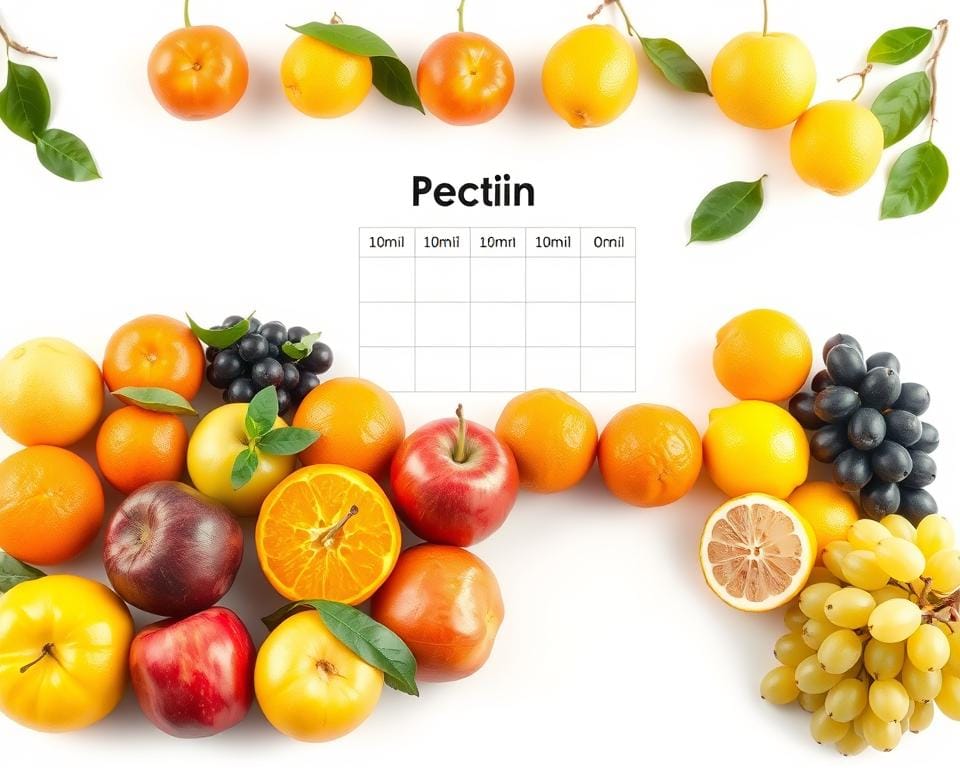
Quick answer: The pectin content by fruit chart shows that high-pectin, low-pH fruits — like citrus peel, cranberries, currants, and gooseberries — gel easily with sugar and heat.
I love the tang of a bright, tart jam — the kind that feels glossy on your spoon and snaps on the plate. I grouped common examples and typical pH ranges so you can tell at a glance which set fast and which need help.
Details: Sugar, acid, and pectin work together to form a gel. Low pH (around 2–3.5) and peel or seeds often supply the most natural pectin. Ripe, soft flesh has less pectin and may need added acid or commercial pectin for a reliable set.
Note: I also flag how ripeness and variety change levels and include a simple home test — never ingest the test mix — so you can adjust recipes with confidence. 😊
Key Takeaways
- High-pectin + low pH = easy gelling (citrus peel, cranberries).
- Soft ripe flesh often needs added acid or pectin.
- Sugar, acid, and pectin must balance for a firm set.
- Use the table to match sugar and acid to the levels shown.
- Ripeness and variety change natural pectin — test if unsure.
Quick answer: which fruits are high, medium, or low in pectin?
Here’s a fast rundown of which fruits give a firm set and which usually don’t. I keep this short so you can pick partners for jams quickly — and get reliable results. 😊
- High pectin, low acid (set fast with just sugar): lemons, limes, cranberries, blackcurrants/red currants, oranges, grapefruits, gooseberries, mandarins.
- Medium pectin (often sets well; may need a squeeze of lemon): apples, grapes, blackberries — a nice balance of sugar and acid.
- Low pectin (usually need added pectin or more acid): strawberries, peaches, raspberries, blueberries, apricots, cherries, figs, plums, pears, melons.
Tips: If a fruit tastes tart, its acid likely helps gel formation. Sweeter picks often need extra acid or commercial pectin. Mix low- and high-pectin items (for example, strawberry + apple) to boost structure.
| Group | Examples | Quick note |
|---|---|---|
| High | Lemons, limes, cranberries, currants, gooseberries | Sets fast with sugar; low pH helps gel |
| Medium | Apples, grapes, blackberries | Often fine with a squeeze of lemon |
| Low | Strawberries, peaches, raspberries, blueberries, melons | Usually need added pectin or extra acid |
pectin content by fruit chart: high-medium-low levels and pH notes
I’ll show a neat, usable list that pairs % sugar with pH and how well each item sets. This helps you plan jams and jellies without guesswork.
How to read the table: Sugar, acid (pH), and natural setting power work together to make a gel. Lower pH helps high-methoxyl agents set at normal sugar levels. Higher sugar reduces free water so chains link and form a clean set.
What changes natural setting power
Ripeness lowers natural binders as enzymes break them down — overripe picks give softer sets. Variety matters: tart apples set better than sweet dessert types. The edible part matters too — peels and seeds, especially in citrus, hold the most setting power.
| Fruit | % Sugar | Avg pH | Setting level |
|---|---|---|---|
| Apple | 13% | 3.5 | Medium |
| Blackcurrant | 10% | 2.8 | High |
| Cranberry | 4% | 2.5 | High |
| Grapefruit | 6% | 3.0 | High |
| Lemon | 2% | 2.0 | High |
| Orange | 11% | 2.8 | High |
| Grape | 16% | 4.0 | Medium |
| Strawberry | 7% | 3.4 | Low |
| Peach | 9% | 3.8 | Very low |
Tip: If your picks sit near pH 4.0, add lemon juice to nudge acidity into the gel-friendly zone.
Apply the chart to jams and jellies: sugar-acid-pectin balance
Start with a clear plan: match sugar and acid to each fruit’s natural setting power. I walk through practical steps for making jam and jelly that set well. Short cooks keep bright flavor; long cooks can dull it.
High-pectin, low-pH fruits
High-pectin, low-pH examples
Citrus peels, cranberries, currants, and gooseberries often need no extra gelling agent. Cook with sugar to reach about 65% soluble solids for HM gels. For marmalade, tie peel and pips in a muslin bag — they release natural binders and clear the liquid. Cranberry jelly gels fast; watch the sheet test so you don’t overcook.
When apples and grapes need help
Apples and many grapes sit in the middle. Add lemon juice to lift acid when pH is near 4.0. If grapes are very sweet, a small dose of commercial gelling agent gives a firmer jelly. For apple jelly, include cores and peels for stronger structure.
Low-pectin picks
Tips for strawberries, peaches, and blueberries
Low-pectin items usually need added gelling agent or blending with high-pectin partners. For strawberry jam, follow the gelling packet directions or mix in apple or red currant. Blueberry jam benefits from extra acid and a short cook time to keep flavor bright.
- Control sugar: it strengthens HM gels but can hide flavor.
- Test set: cold-plate or sheet test; target ~220°F at sea level for a precise gel.
- Aim: balance sugar, acid, and gelling agent so jams slice cleanly and taste fresh.
| Category | Strategy | Example | Notes |
|---|---|---|---|
| High-pectin, low-pH | Cook with sugar; no extra gelling often | Cranberry jelly | Fast gel; watch sheet test |
| Medium-pectin | Add lemon juice; consider small gelling dose | Apple or grape jelly | Use cores/peels for apple |
| Low-pectin | Add commercial gelling agent or blend | Strawberry or peach jam | Short cook + extra acid helps flavor |
| Citrus method | Peel/pips in muslin bag during cook | Orange marmalade | Improves gel and clarity |
Pectin science in brief for cooks and food science readers
Let’s cut to the science—simple facts that help you cook and experiment with confidence. I keep this short and practical so you can use it at the stove or in a lab notebook. 😊
What it is and why ripening lowers firmness
Pectin is a plant cell-wall polysaccharide rich in galacturonic acid. It acts like glue between cells. As fruit ripens, enzymes such as pectinase and pectinesterase break that glue down. The result is softer texture and weaker gel potential.
High-methoxyl vs low-methoxyl — gel ranges and use
High-methoxyl (HM) gels when there is plenty of sugar and moderate acid. Aim for soluble solids above 60% and pH about 2.8–3.6 for a firm set.
Low-methoxyl (LM) gels with calcium, not lots of sugar. LM works across a wider pH range (roughly 2.6–7.0) and at 10–70% solids — great for reduced-sugar recipes.
Citrus peel vs flesh — where natural pectin concentrates
Citrus peel holds much of the natural pectin. That is why marmalade and peel-steep methods give a strong set. Typical food use levels run about 0.5–1.0% for a usual process.
Tip: Warmer, longer cooking can degrade the setting agent — short cooks or added agent keep bright flavor and structure.
| Type | Gelling trigger | pH range | When to use |
|---|---|---|---|
| High-methoxyl (HM) | Sugar + acid | 2.8–3.6 | Traditional jams and jellies |
| Low-methoxyl (LM) | Calcium | 2.6–7.0 | Low-sugar or set-with-calcium recipes |
| Citrus peel | Natural binder | ~2.0–3.5 | Marmalades and peel-rich preserves |
Testing and sourcing pectin for consistent gel
I test small batches so I can fix a recipe before I boil the whole pot. This saves time and helps me get a reliable set every season. 😊
Simple rubbing-alcohol test to estimate gel power
Quick steps: Mix 1 tsp of cooked, cooled crushed fruit with 1 Tbsp rubbing alcohol in a closed jar. Shake gently for 10–15 seconds.
If a firm lump forms, the sample has plenty of natural gelling agent. If only small particles appear, the sample is low and may need help.
Safety warning: Do not taste or ingest the mix—rubbing alcohol is poisonous. Label and discard the sample safely.
Natural sources and commercial options
Good natural sources include just-ripe apples, crabapples, and citrus peels. Tie peels or cores in a muslin bag during the boil to boost gel.
Commercial types come as powdered or liquid. Look for HM for classic high-sugar jam. Choose LM or amidated for low-sugar processes. Follow the brand directions—forms are not interchangeable.
Quick uses: Use the alcohol test before a big batch. Add lemon or a commercial packet if the test shows low gelling power.
| Source | Form | Best for | Note |
|---|---|---|---|
| Just-ripe apples / crabapples | Natural extract | Apple jelly, boosters | Core/peel helps in the process |
| Citrus peels | Natural peel steep | Marmalade, high-acid jams | Tie in muslin for clarity |
| Powdered / Liquid | Commercial | Consistent jam and low-sugar recipes | Follow label; powdered ≠ liquid one-to-one |
| Waste streams | Apple pomace, dried peels | Industrial extraction | Common source for commercial natural pectin |
Nutrition, dietary fiber, and safe use
Simple numbers about intake and food use will keep your recipes on track. I like clear guidance—short, practical, and kitchen-friendly. 😊
Typical intake and functional effects
Average intake: Eating about 500 g of fruits vegetables gives roughly 5 g of soluble dietary fiber. That estimate includes common kitchen picks and raw snacks.
Food use level: Typical use in processed goods runs about 0.5–1.0%. That mirrors the natural levels found in many fresh preserves and helps with texture without overdoing it.
The soluble fiber can modestly lower LDL cholesterol—about 3–7% in controlled studies. It also slows glucose absorption a little and ferments in the colon to short-chain fatty acids that support gut ecology.
Practical tips and safe handling
Citrus-derived and apple-derived pectin are the main commercial sources. Use them as directed—cooking-grade is for recipes, not for taking straight from the jar.
| Measure | Typical value | Note |
|---|---|---|
| Daily intake | ~5 g | From ~500 g produce |
| Food use level | 0.5–1.0% | Good for jams and jellies |
| LDL reduction | ~3–7% | Modest, evidence-based |
For home cooks—avoid excess. Too much can make a spread rubbery and mute flavor. Balance sugar and acid so the jar tastes fresh.
If you have a sensitive gut, increase fiber-rich foods slowly and drink water. Check package labels when buying supplements and rotate stored pectin—keep it cool and dry for best potency.
Evidence and data notes for this chart
I reviewed primary extension guides and lab studies to build a practical, kitchen-ready summary — and I kept it short and useful. 😊
Key sources: National Center for Home Food Preservation (University of Georgia), Baker R.A., J. Food Sci. (1997) review, and Ohio State University Extension. These authorities explain how levels shift with ripeness, variety, and which part of the produce is tested.
Why numbers vary: Ripening enzymes lower natural gelling agents as fruit softens. Different labs measure soluble versus total amounts, so two reports can disagree for the same sample.
- Sampling matters: Peel and seeds often show higher levels than flesh alone — citrus peels are a prime example.
- Method differences: Soluble vs. total assays and extraction techniques change reported values.
- Practical note: Use the table as an average guide — test small jars for a reliable set when batches are precious.
Note: For consistent jams, control acid and sugar — process parameters often matter more than small measurement differences in lab reports.
| Source | What it offers | Practical tip |
|---|---|---|
| NC HFP (UGA) | Home-canning guidance | Follow tested acid/sugar ranges for safe, repeatable jams |
| Baker, J. Food Sci. (1997) | Lab review of levels and methods | Expect variability across studies and methods |
| Ohio State Ext. | Practical processing ranges | Use cores/peels to boost structure when needed |
Conclusion
A reliable jar starts with a simple rule—measure, test, adjust. I use the chart as a guide and then tweak acid and heat until the set looks right.
Match natural pectin levels to the right sugar and acid, and the gel follows. For low-methoxyl picks, add lemon or a commercial booster, or pair low and high examples for balance.
Keep batches consistent: weigh ingredients, measure acid, and test a small jar before you process the rest. My go-to is a muslin bag with citrus peel or apple cores for a natural boost—easy win. 😊
Next step: pick one seasonal fruit, apply the balance, note the result, and enjoy better jams every time.
Leave a Reply